ผศ.ดร.เด่นพงษ์ สุดภักดี
ภาควิชาวิศวกรรมเครื่องกล คณะวิศวกรรมศาสตร์ มหาวิทยาลัยขอนแก่น
[26]


Example
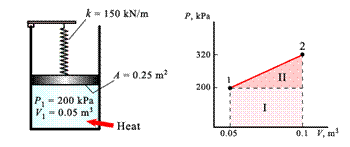
A piston-cylinder device
contains 0.05 m3 of a gas initially at 200 kPa. At this
state a linear spring which has a
spring constant of 150 kN/m is touching the piston but exerting no force on it. Now heat is transferred to the gas,
causing the piston to rise and to compress the spring
until the volume inside the cylinder doubles. If the cross-sectional area of the piston is 0.25 m2, determine (a) the final pressure inside the cylinder, (b) the total work done by the gas, and (c) the
fraction of this work done against the spring to compress it.