|
1
|
- Asst.Prof.Dr.Denpong Soodphakdee
- Department of Mechanical Engineering
|
|
2
|
- Also called the conservation of energy principle.
- Energy can be neither created nor destroyed; it can only change forms.
|
|
3
|
- The net change (increase or decrease) in the total energy of the system
during a process is equal to the difference between the total energy
entering and the total energy leaving the system during that process.
|
|
4
|
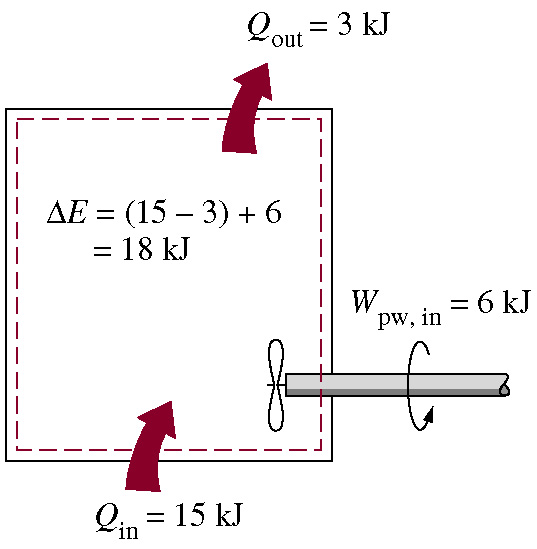
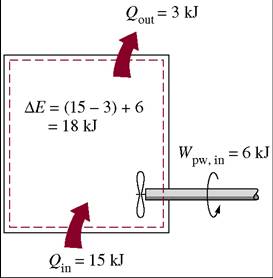
- The energy change of a system during a process is equal to the net work
and heat transfer between the system and its surroundings.
|
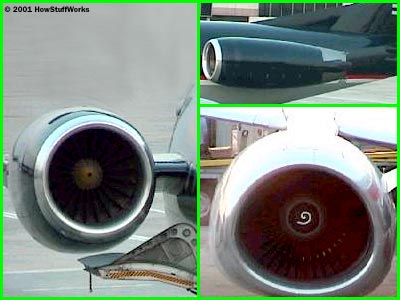
|
5
|
- Energy change = Energy at final state – Energy at initial state
- Energy is a property, the value of a property does not change unless the
state of the system changes.
- Energy can exist in numerous forms such as internal (sensible, latent,
chemical, and nuclear), kinetic, potential, electric, and magnetic.
|
|
6
|
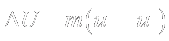
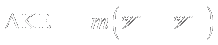
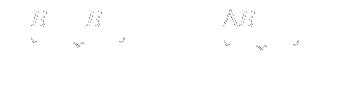
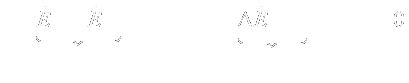
- Neglecting electric, and magnetic energy, the total energy change is
|
|
7
|
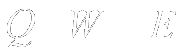
- Energy can be transferred to or from a system in three forms: heat, work,
and mass flow.
- For a fixed mass system (closed system), there are only two forms of
energy interactions associated with the system are heat transfer and work.
|
|
8
|
- Heat Transfer, Q
- Heat transfer to a system (heat gain) increases the energy of the
molecules and thus the internal energy of the system, and heat transfer
from a system (heat loss) decrease it since the energy transferred out
as heat comes from the energy of the molecules of the system.
|
|
9
|
- Work, W
- An energy interaction that is not caused by a temperature difference
between a system and its surroundings is work. Work transfer to a system
(i.e. work done on a system) increase the energy of the system, and work
transfer from a system (i.e. work done by the system) decrease it since
the energy transferred out as work comes from the energy contained in
the system.
|
|
10
|
- Mass Flow, m
- Mass flow in and out of the system serves as an additional mechanism of
energy transfer. When mass enters a system, the energy of the system increases
because mass carries energy with it (in fact, mass is energy). Likewise,
when same mass leaves the system, the energy contained within the system
decreases because the leaving mass takes out some energy with it.
|
|
11
|
|
|
12
|
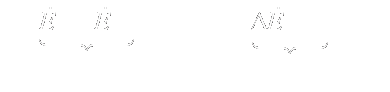
- The energy balance can be written more complicitly as
|
|
13
|
- For a closed system undergoing a cycle where the initial and final
states are identical.
- For closed system there is no mass across boundaries
|
|
14
|
- Referring to heat and work sign convention, the energy balance relation
becomes
|
|
15
|
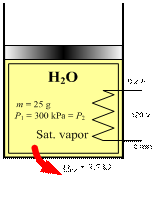
- A piston-cylinder device contains 25 g of saturated water vapor that is
maintained at a constant pressure of 300 kPa. A resistance heater within
the cylinder is turned on and passes a current of 0.2 A for 5 min from a
120-V source. At the same time, a heat loss of 3.7 kJ occurs.
- show that for a closed system the boundary work Wb and the
change in internal energy DU in the first-law relation can be combined into
one term, DH,
for a constant-pressure process.
- Determine the final temperature of the steam.
|
|
16
|
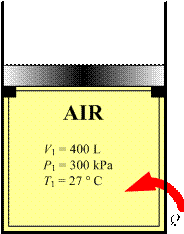
- A piston-cylinder device initially contains air at 150 kPa and 27°C. At this state, the
piston is resting on a pair of stops, as shown, and the enclosed volume
is 400 L. The mass of the piston is such that a 350-kPa pressure is
require to move it. The air is now heated until its volume has doubled.
Determine
- the final temperature,
- the work done by the air, and
- the total heat transferred to the air.
|
|
17
|
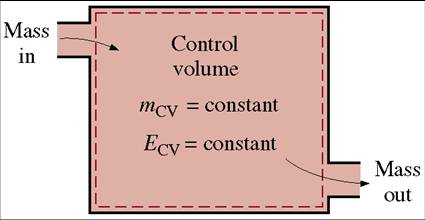
- Steady-flow process -: a process during which a fluid flows through a
control volume steadily.
|
|
18
|
- Mass balance :
- Single inlet – Single exit
- Multiple inlets – Multiple exits
|
|
19
|
- During a steady-flow process, the total energy of a control volume
remains constant, and thus the change in the total energy of the control
volume is zero.
- or
|
|
20
|
- Energy can only be transferred by heat, work, and mass, therefore energy
balance equation becomes
|
|
21
|
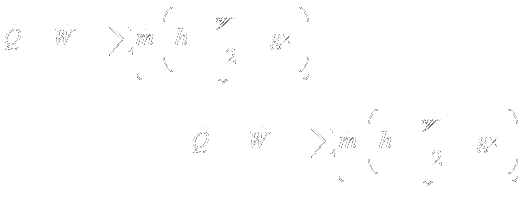
- It is common practice to assume heat to be transferred into the system
(heat input) and, work produced by the system (work output), and then
solve the problem.
- The first law or energy balance relation in that case for general
steady-flow system becomes
|
|
22
|
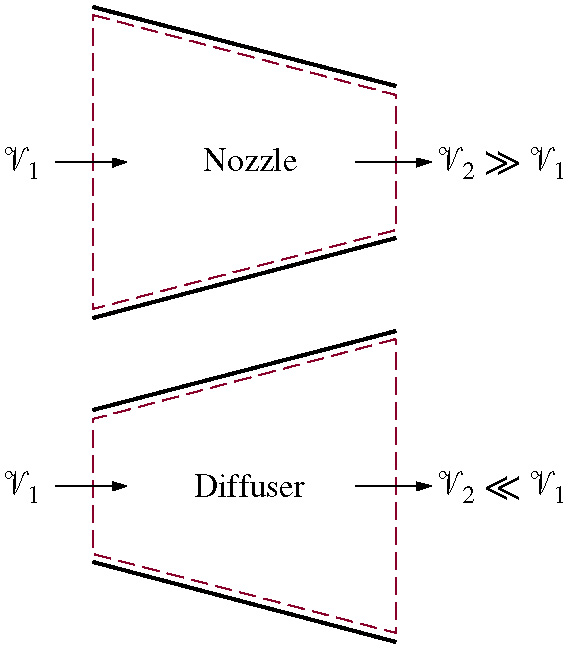
- A nozzle is a device that increases the velocity of a fluid at the
expense of pressure.
- A diffusers is a device that increases the pressure of a fluid by
slowing it down.
|
|
23
|
|
|
24
|
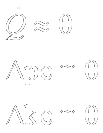
- Heat transfer is usually very small.
- Involve no work.
- Neglect change in potential energy.
- Involve only kinetic energy change.
|
|
25
|
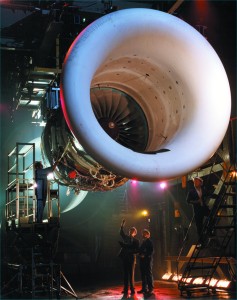
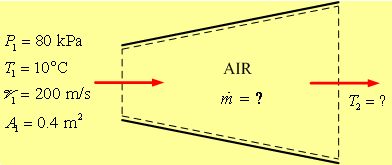
- Air at 10°C and
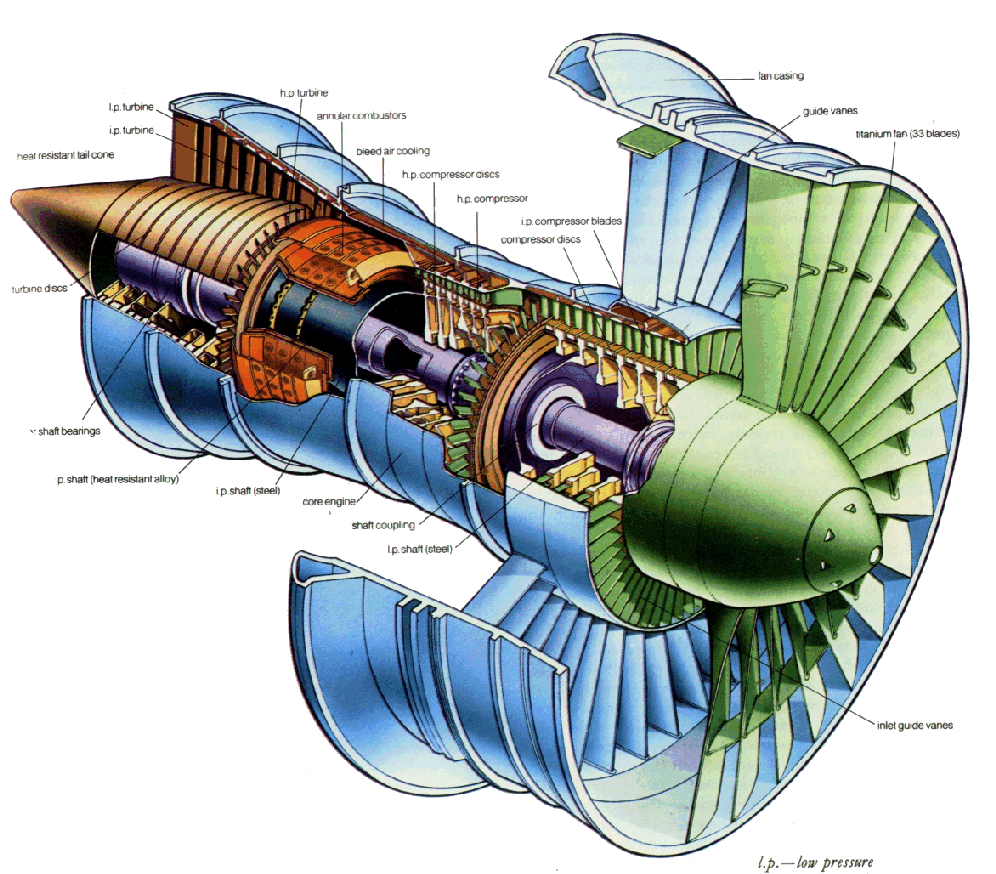
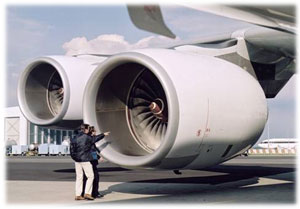
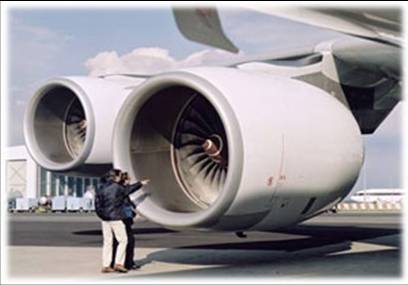
80 kPa enters the diffuser of a jet engine steadily with a velocity of
200 m/s. The inlet area of the diffuser is 0.4 m2. The air
leaves the diffuser with a velocity that is very small compared with the
inlet velocity. Determine
- the mass flow rate of the air
- the temperature of the air leaving the diffuser.
|
|
26
|
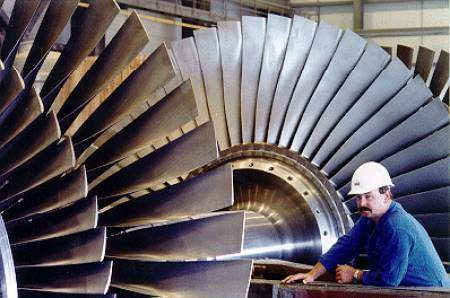
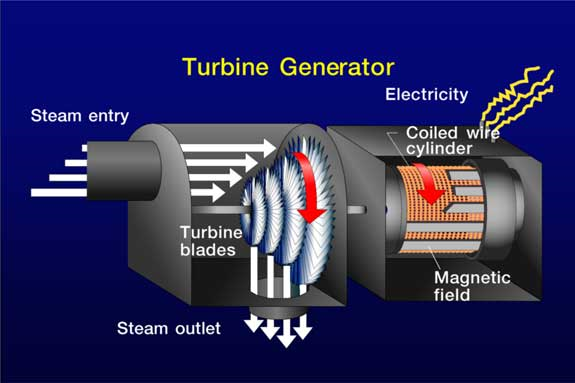
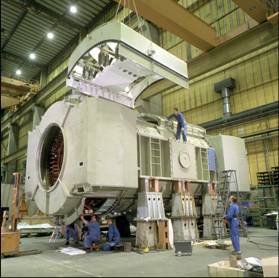
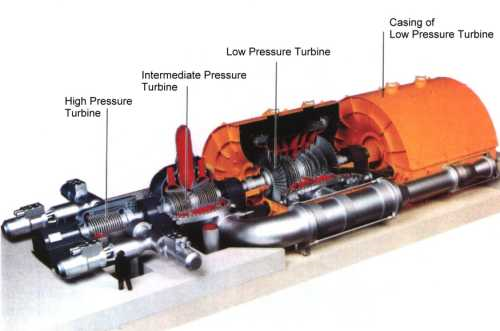
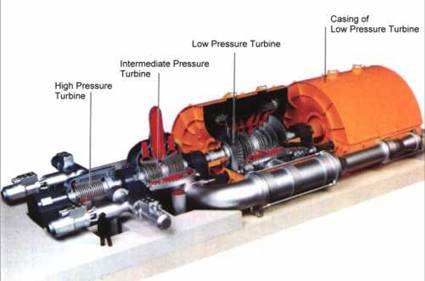
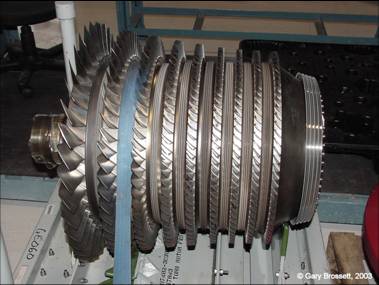
- Turbines produce power output.
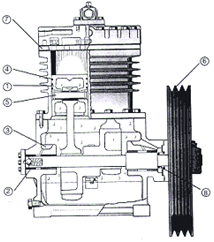
- Compressors, pumps, and fans require power input.
- No heat transfer, change in potential and kinetic energies.
|
|
27
|
|
|
28
|
|
|
29
|
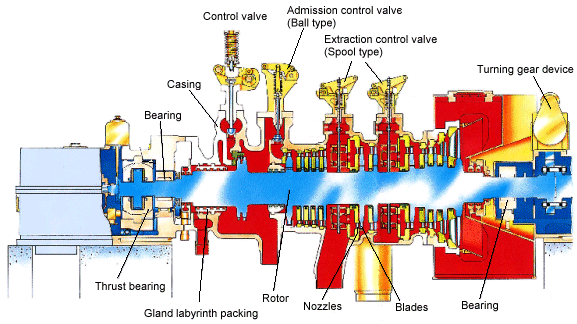
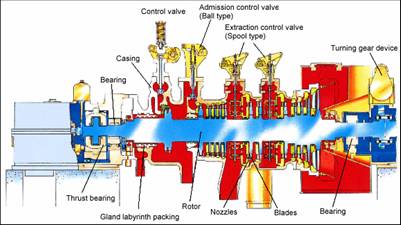
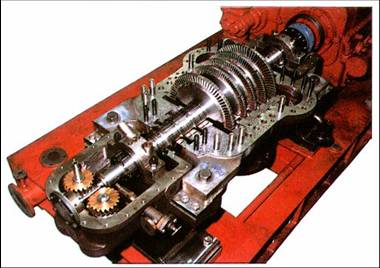
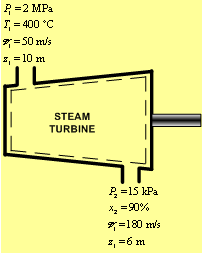
- The power output of an adiabatic steam turbine is 5 MW, and the inlet
and the exit conditions of the steam are as indicated in the figure.
- (a) Compare the magnitudes of Dh, Dke, and Dpe.
- (b) Determine the work done per unit mass of the steam flowing through
the turbine.
- (c) Calculate the mass flow rate of the steam.
|
|
30
|
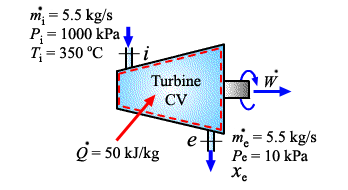
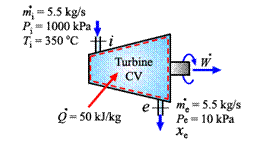
- A steam turbine receives steam at 1000 kPa and 350°C. The mass flow rate of the steam is 55 kg/s.
The heat loss from the turbine is 50 kJ/kg of steam. It is known that
the power output of the turbine is 40´103 kW . If the turbine exhausts at 10
kPa, determine the quality of the steam leaving the turbine.
|
|
31
|
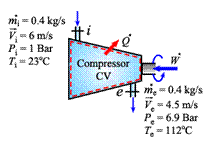
- Air flows steadily at the rate of 0.4 kg/s through an air compressor,
entering at 6 m/s with a pressure of 1 bar and a temperature of 23°C, and leaving at 4.5
m/s with a pressure of 6.9 bar and a temperature of 112°C. The rate of heat
transfer from the compressor to the surrounding is 60 kW. Calculate the
power required to drive the compressor and the inlet and the outlet pipe
cross-sectional.
|
|
32
|
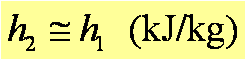
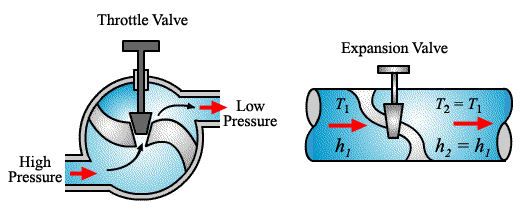
- Throttling valves are any kind of flow-restricting devices that cause a
significant pressure drop in the fluid.
|
|
33
|
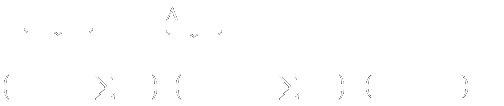
- Mass balance :-
- Energy balance :-
|
|
34
|
- A rigid, insulated tank that is initially evacuated is connected
through a valve to a supply line that carries steam at 1 MPa and 300°C. Now the valve is
opened, and steam is allowed to flow slowly into the tank until the
pressure reaches 1 MPa, at which point the valve is closed. Determine
the final temperature of the steam in the tank.
|

 Notes
Notes